Showing posts with label museum. Show all posts

Wednesday, April 30, 2014

Alcalá de Herares

Alcalá de Herares is one of the lesser known (for tourists outside of Spain) day trips that you can take from Madrid. I had never been, which is a shame, because really it was very close. It is just NorthEast of the city. We got there in about an hour, and you can also get there in about an hour from the center of Madrid using the Cercanías (regional trains).

We went this weekend with some friends to see the town and also to go to the Museo Archqueológico Regional (English information link here). They have an special exhibit "La Cuna de la Humanidad" (the footprint of humanity) which has only before been seen in Africa.

Special exhibit 

I feel like I should make the disclaimer that the museum's regular collection is only in Spanish. Since this is only a regional museum it is only about the history in what is now the providence or "Ayuntammiento" of Madrid. However the exhibits are thoughtful out together and even starts with a rather impressive Imax-eske video dating back 460,000,000 years ago to present. I had no idea that a once the "safari" animals called Spain home too!

A relic of Roman occupation, Achilles defeating the Amazonian Queen  


As for the Special exhibit it was very cool to see a copy of "Lucy" and alsoof footprints of our early ancestors. It also went into great detail on the Leaky family and their contribution to our understanding of evolution.

"Lucy"

I always look for  textile paraphernalia in museums. These are "fusayolas" which mean spindle whorls in Spanish. I have more pictures of more whorls from this museum, but that might get it's own post. If they are like other spindles I have seen here in Spain, they probably had a carved shaft, about 25-30cm long, with a spiral leading to a point at one end to encourage the fiber to rotate off the point. However there was no information here.


The absolute best thing about this museum (or my favorite, anyway) was the tiny gift shop. Now, I have been to many museums and they are usually filled with t-shirts, postcards and books, not that those things are bad, but this museum had replicas and kits! Look I got a spindle whorl replica and a cave painting kit (complete with dye stuff, background stone and your own stick brush with hair at one end). I love this kind of thing. These alone made my whole day.


Across the street from the museum is the Archbishop's palace, which was very photogenic. 


Catalina de Aragón


We also saw the house were Cervantes was born Spanish linkEnglish link. That house had two spinning wheels and an old fashioned bobbin winder! Unfortunately taking photos was not allowed inside.

Image taken from the museum's website.

The beautiful Cervantes plaza already has huge roses blooming, and was surrounded by beautiful views in all directions.


I am fascinated by the herons and their huge nests/obsession for church towers.


Even the side streets are cute here.


The old mosque, still very picturesque.

Monday, September 2, 2013

Lisbon day 3. Yarn shops and Museu Nacional do Azulejo

This was the day I had completely to myself to explore the city. Now I do not know about you, but I still find it a little scary to venture off by yourself in a country where you do not speak the language. I know that people do it every day, but this was my first time.

I, of course, spent the morning looking up the local yarn stores. The first one was in walking distance from my hotel and is called Tricots Brancal. It was closed for August. I had a peek inside though and from the window and it looked like it had a good selection. I was not courageous enough to get a photo but here is a link to it's location.

Then I went to a different than usual metro stop and on the way I past this beautiful recycling bin.


The next shop I went to was downtown. It had a beautiful mosaic tiled sign on the sidewalk, a fair percentage of businesses in Lisbon do, but from what I could see, it was not worth going into.


There are several of these types of stores in Madrid should I wish to go. Plus in Madrid, I speak the language. As for how I would explain these type of stores to Americans... it is like a big box craft store in a small space. Because it is a small space, you need to have an idea of what you are looking for. In other words, it is not a store you can browse easily in. For example if you want buttons, you go in ask to see their button samples. The clerk will then hand you a book from under the counter with samples of all the buttons they carry, you can select one and they will go into the back and get it for you. Most of the stuff that they carry is on display in the windows, so you should have a good look at what is there before going inside.


A beautiful building on the other side of the street.
I had saved the best  store for last. Retrosaria. From everything I have heard, this is the best yarn/fabric shop to visit as a tourist in Madrid. Not only the owner speaks english, but the saleswoman that was working that day did as well. They have handspun 100% Portuguese wool (grown, spun, dyed), Portuguese merino wool to spin or felt, and several yarns and fabrics from Portugal.

The shop can be intimidating to find, as it feels like you are going up to an apartment building. I highly recommend going to the website and looking at the directions to get there. It is on the 2nd (US 3rd) floor with no elevator.

There is also a selection of international yarns, notably German, sewing and knitting books and fabrics.

I can not really hand sew and I do not have a sewing machine, but I saw some fat quarters from Japanese fabrics there that I knew that I would want in the future. I bought both a lab science one and an underground science one, as well as some Portuguese designed ribbon with Snow White (shown) and Little Red Ridding Hood (not shown).


True

This is what I bought. Admittedly most of it was German made, but the fiber is100g of Portuguese Merino in a natural brown, and the cotton yarn on the lower left is Portuguese made 100% recycled denim yarn. 


Outside the yarn store I found another ship.


Then I did my most adventurous thing yet. I headed to the Praça do Comércio to try and catch a bus to the Museu Nacional do Azulejo (Tile Museum). Now I knew the numbers of the busses that went there, and that they stopped in the Praça, and I got there ok. I just wish that I had looked up more information ahead of time though. the Praça is huge with bus stops on three sides and in two different lanes. Eventually I thought that I had found the bus that I wanted and I waited patiently to ask the driver if he went to the Museum. Luckily he spoke a little of English and I was able to point out the museum on the map so he was able to help me.

Here is a shot I took from the bus. Not the best, but a good view of the city as seen from the bay.


Lisbon is known for it's tiles or "Azulejos". I knew that I had to try and get to this museum because it was so unique and also craft related. I think that it is inside an old convent. The entrance fee is reasonable, 5€, and there was a beautiful courtyard with a nice cafeteria, which is nice because this Museum is off the beaten tourist path.


I did not see any signs saying not to take pictures, so I took a few sans flash. I found I really liked the repeating geometric tiles. These ones looked like they were 3D.


Here they explained (in English too) how they would paint the tiles. How they transferred the designs was particularly interesting. They would use the "prick and pounce" method which I almost used for my stained glass kits. Here is a good explanation of the technique.


There was also an old chapel in the center of the museum.


What I assume is a reliquary with a modern ceramic sculpture in font of it. It was a little creepy.


I found some sheep in the tiles too.


I have to admit that I took a taxi back to the hotel. I usually do not do that, but I was unsure of where the bus stop was going back and it was going to be a bus trip, a long walk uphill and then a metro to get there. There were taxies in front of the museum and it only cost about 3€ more then my proposed trip on public transportation.


Tuesday, July 23, 2013

Museo Etnologico de Chinchón/ ethnological museum of Chinchón

There is a nice little folk museum in Chinchón, and it is the main reason for us going there. We knew that there was a textile section. So how do you find this museum on an out-of-the-way side street? If you are in the plaza mayor and facing the church you will make out that there is a pedestrian archway up and to the left.

Hay un pequeño museo etnológico en Chinchón, y es la razón principal por la que fuimos allí. Sabíamos que había una sección textil. Así que, ¿cómo encontrar este museo en una pequeña y apartada calle? Si estás en la Plaza Mayor y encarando la iglesia verás que hay una arcada peatonal arriba y hacia la izquierda.


Here is a close up of the archway. I should probably take this opportunity to mention it is a very small museum, and the information signs are only in Spanish.

Aquí podéis ver un primer plano de la arcada. Probablemente debería aprovechar esta oportunidad para mencionar que es un pequeño museo, y que toda la información está sólo en español.


You go through and  will see this sign to your left, then you know that you are on the right track. It is just up this road about 100 meters to your left.

Cuando cruces verás esta señal a la izquierda, entonces sabrás que estás en el camino correcto. Está a unos 100 metros a la izquierda.


Technically I was not allowed to take these pictures. However, I took these without flash and for educational purposes. The main textile section is up on the 2nd (for the US the 3rd) floor. There is a selection of traditional clothing that you can see as you enter the museum, but up here you can see the tools used for making the textiles.

Técnicamente no se me permitió tomar estas fotos. Sin embargo, las tomé sin flash y con propósitos educativos. La sección textil principal está arriba en el segundo piso. Hay una selección de ropa tradicional que se puede ver al entrar en el museo, pero en el segundo piso puedes ver las herramientas que se utilizan para la fabricación de los textiles.

There were hanks of wool hanging from the rafters and the walls. There were really no signs about the wool, other than who donated it, but they remind me of the skeins at the Royal Tapestry Museum in Madrid. The skeins at the Tapestry museum were from Spanish Merino and spun and dyed somewhere in Toledo. Since there were also no signs saying not to touch, I did, and it certainly felt like 100% wool that could have been Spanish merino.

Había madejas de lana colgando de las vigas y las paredes. No había señales sobre la lana, excepto quien la donó, pero me recuerdan a las madejas en la Real Fabrica de Tapices en Madrid. Los ovillos en el museo de tapices eran de merino Español, hilados y teñidos en Toledo. No había señales diciendo que no tocara, así que lo hice, y ciertamente parecía 100% lana que podría haber sido merino Español.


They look like could have been dyed with natural dyes too.

También parecían haber sido teñidos con tintes naturales.


Here are the two informational signs located to the side of a huge rug loom.

Estos son los dos carteles informativos situados al lado de un enorme telar de alfombras.


My translation of the sign below:
"In the 1950s there were many grand mansions that were converted into workshops for making Spanish knotted rugs. The female pioneers that started this activity and gave jobs to around 200 local women were 14 young women that learned in the a foundation called Fundación Generalísimo.
At full capacity they worked (in this city) on around 50 looms until 1967, at this time this type of work practically disappeared.
Each woman had her own space of 120 rows to knot, which measured about half a meter and they received 8 pesetas (0.048€) for every 100 knots. She was only paid when the rug was finished. The weavers that wanted to receive a reasonable salary would have had to do 12,500 knots each day.
A rug that was 3.5meters long and 2.5 meters wide would have been woven by 5 women and made in 15 days. It would have been sold for 15,000 pesetas (less than 100 Euros).
It was very hard work, because of the tightness of the warp and the continuous use of scissors caused various deformities to the woman's hands; added to this was the fact that the wool gave off a noxious dust that the workers continually breathed in.
Something particular about the "Spanish knot" technique is that you don´t use any type of machine: all of the process is done by hand, every thread is a knot, and knot by knot you weave the rug to completion. The peculiarity that there are neither shuttles nor any other type of mechanism has situated our rugs among the best in the world. If you examine the back of the rug you can see the same design that you see on the front."

Arriba está la traducción en inglés de este cartel; pulsa para ampliar y leer el cartel original en Español.

This next sign reads:
"Antique loom of Chinchón, 
for rugs using Spanish knot
(first part of the 20th century)
Recovered by this museum, and actually put to work to make rugs again.
The loom and all of the skeins of wool were donated by Mr. Pedro Del Nero."
So here is the loom. Hand knotted rug means that instead of weaving, each point of color is knotted around the warp and the ends are snipped off with a pair of scissors. So the knots are at the base of the rug and the yarn ends serve as the carpet pile. Every couple of rows of knots there is a line of jute fiber put in between the warp and packed down. The jute fiber adds stability and longevity to the rug. What I know about the "Spanish knot" that remember from my tour of the Royal tapestry museum, is that it is a different and more complicated knot than regular hand knotted rug.

Así que aquí está el telar. Una alfombra de nudos implica que, en lugar de tejer, cada punto de color se anuda alrededor de la urdimbre y los extremos se cortan con unas tijeras. Así que los nudos están en la base de la alfombra y los hilos terminales son como el pelo de la alfombra. Cada par de filas de nudos hay una línea de fibra de yute que se pone entre la urdimbre y se compacta. La fibra de yute añade estabilidad y longevidad a la alfombra. Lo que sé sobre el "nudo español" de lo que me acuerdo de mi recorrido por la Real Fabrica de Tapices, es que es un nudo diferente y más complicado que otros nudos.

Do you see the drawing behind and in front of the weft? (Click to enlarge.) That is called a cartoon and is kind of a colored graft that allows the rug makers to follow the pattern. 

¿Ves el dibujo detrás y delante de la urdimbre? (Haz clic para ampliar.) Eso se llama un cartón y permite a los fabricantes de alfombras seguir el patrón.


A side view of the loom, where you can see that you can raise or lower the loom to get the right tension on the warp.

Una vista lateral del telar, donde puedes ver que se puede subir o bajar el telar para obtener la tensión correcta en la urdimbre.


This is a warping board. The zig-zag pegs at either end make it possible to measure a very long warp in a small space.

Esto se usa para medir el urdido. Las clavijas en los dos lados hacen que sea posible medir un urdido muy largo en un espacio pequeño.


A finished Spanish knotted rug hung up on the wall.

Una alfombra de nudo español acabada y colgada en la pared.


A close up of the rug that was hanging on the loom. Just imagine how plush it would be for tired feet, especially in winter. If this post has made you want your own Spanish knotted rug I believe that the Royal tapestry museum still makes them to order, but I have to warn you they do pay their laborers fair wages and these take hours to make, so it will be an investment.

Un primer plano de la alfombra que colgaba en el telar. Imaginaos la sensación para los pies cansados​​, especialmente en el invierno. Si este post te ha hecho querer tu propia alfombra de nudo español, creo que en la Real Fabrica de Tapices todavía los hacen de encargo, pero tengo que advertirte que pagan a sus trabajadores salarios justos y se tardan muchas horas para hacer una alfombra, por lo que será una inversión.


Wednesday, June 12, 2013

Madrid food tour take two

I was lucky enough to go on another Madrid Food Tour this past Saturday. This time the tour was History, Tapas, and Taverns.

You can read about my first Madrid food tour, complete with pictures of food here. "Complete with pictures of food" you think, "why would a blog post about a food tour not have photos of the delicacies?" Simple enough, this blogger forgot to take pictures of the food. I was so enthralled by the history on the tour and the company, I simply forgot.

If you want to see some really wonderful pictures of Spanish food, I recommend that you go to the Spanish Sabores blog.

So lets talk about my night. I do not go downtown very often, and every time that I do I wonder why I do not go more. However, I have been downtown since I have moved to my new apartment, and when I go downtown I get off at the
Ópera metro station. I have never noticed that there is a small museum in the station!


It is the Museo de Caños de Peral (Spanish link) and it is pieces of a 16th century Aquaduct. At the time the museum was closed and we had a tour to go to, so my photos are through the glass. I definitely want to go back soon to see it, and I will report back on my findings. 


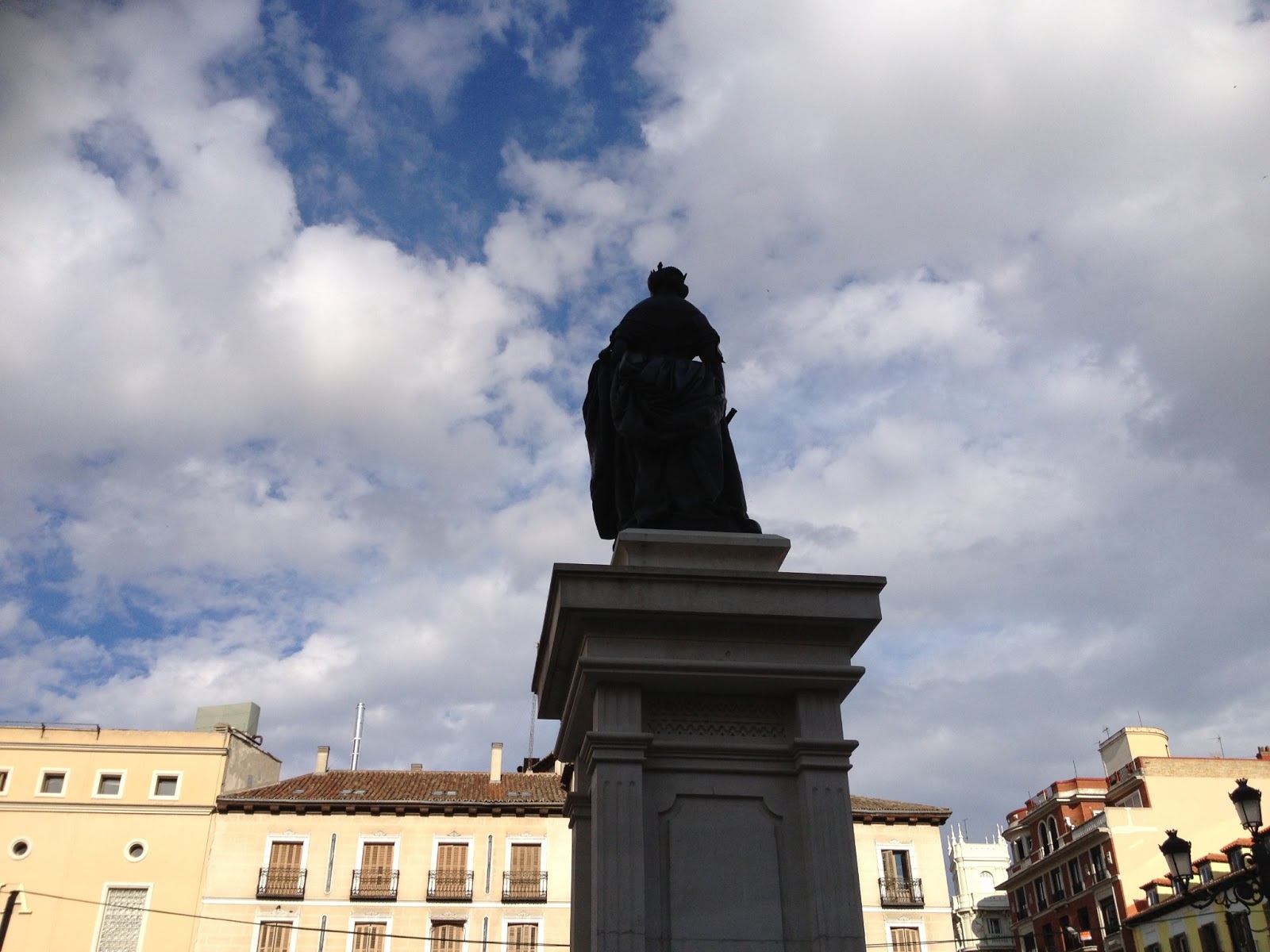
We met up with our tour guide, James, in the Plaza Isabel II. Here is a photo of the back of that queen dramatically backlit against the Madrid skyline.


I took some more photos of the views around the plaza. It really is one of the most beautiful plazas in the city.


If you are wondering what those little buildings are, there was a little market going on in the plaza. They were selling: cheese, baked goods, roasted nuts, wine, crafts, and clothing. These little markets pop up in Madrid all of the time, and I love them.


But we were not here to buy, we were here to tour.


As mentioned before, I was not really taking photos that night. To see all of the sights and to hear all of the history you really have to try the tour yourself. But I remember a couple gems that I will share with you. Below is a statue of Phillip the IV made in the 16th century. It is the first bronze statue, in the world, of a rearing horse. Galileo was asked helped to design it as they wanted the horse to rear, but it was not very stable on just the two legs. Galileo solution: the horse is also supported by it's tail which you can not see from the ground.


This beautiful building, located in Plaza Villa, was at one time the town hall of Madrid. It still serves as government offices.


If you walk around the corner, ok across the plaza and down Calle de Codo you will come to this door.
One day, I am going to do this (it was closed at the time of the tour). Here you can buy cookies from cloistered nuns. You ring the buzzer (ring the correct one as the others call the (non-cookie) nuns or the priests to come and consult with you about spiritual matters). Apparently you go in, and travel down a hall to arrive at a sort of wooden lazy susan in the wall. You talk with the nun about your cookie order, they are cloistered so you can not see them, and then you put the money in your half of the lazy susan and they turn it to take it and turn it back to give you your cookies and your change. I heard about this way before I moved to Madrid, and it did not think that it existed anymore. I will try this out too, and report back to you.


A small plaza across from the nuns a quiet and beautiful area of Madrid.


I leave you with an image of Federico García Lorca in the literary quarter. I am told his a wonderful poet and a good illustrator too. Read his history, if you dare, but I warn you it has a sad ending.