Showing posts with label spinning. Show all posts

Wednesday, January 8, 2014

Fabrica de lanas de Arségual


This Christmas I got one of the best and most thoughtful presents from my beloved Sister-in-law (SIL). She sent me 6 natural colored (same color as the sheep) skeins, two each of white, grey and dark brown. She and her partner had toured the countryside in Catalonia at the end of September and ended up going to Fabrica de lanas de Arségual. An actual Spanish mill, with a really mule-Jenny! I had no idea that there was a working mill here in Spain, let alone one so historic!
Since there are a lot of blog/videos/ information about this mill in both Spanish and Catalan I thought I would do a post in English, even if I have yet to visit the mill, after all, I do now have 6 very precious Spanish made skeins. Hopefully I will have translated all of the information right. If any of you have ever been there and have corrections/additions, let me know.

The mill was closed to visitors on the day my SIL went, but she was able to take pictures of the outside the mill and inside the shop. All photos are taken by my SIL unless otherwise noted.

This historic mill is located near the very small town of Arséguel in Catalonia. Here is a link to their website (in Spanish).


The mill
It is completely run on hydroelectric energy, a water-wheel is powered by the river Segre that travels down a kilometer and a half long channel that ends in a 10 meter waterfall. The carders, the mule-jenny and the looms are run on this power. The only non hydro electric energy they use is for the lightbulbs in the factory.

Segre river

Bridge that crosses over the river to the mill

The family that owns the mill have been spinners since 1695 and have been in the building that the mill is now housed since 1902. The machinery that is still in use has been in use since the 18th century.


Luckily for me, the store was open, and she was able to buy me some yarn.

Shop door

Blankets for sale

The mill sells the yarn, socks and blankets....and admits that the yarn has a very rustic feel "The socks made from our wool is adequate for a rigorous climb in the Pyrenees, or a nice sturdy blanket for a shepherd....it might not be comfortable to wear this wool next to your skin". The blankets are made by hydraulic powered looms and the socks are hand cranked on a circular sock knitting machine.

In the picture below you can see what I believe to be the sock knitting machine on the lower right and on the lower left, some sort of electric sock blockers. The yarn in the back is for sale.


Like I said it is possible to take a guided tour, but since my SIL was not able to I have chosen to highlight some photos/videos from Spanish/Catalonian bloggers who have toured it. All sources are noted under the photos. If you read Spanish I invite you to take a look at their posts.

Here is short video that briefly shows a lot of their equipment, and the process.


There are six different machines that the wool passes through to be picked and carded before going to the spinning machines.

One blog states that the picker is known as el diablo (the devil) I wonder if that is just for this particular picker, or for all of them? They do have wicked teeth, I am sure that is where the name comes from.
Source

Everything is water powered. How do they do it? Big leather belts attached to a pole turn by the water-wheel.
Source
Mule Jenny spins woolen spun yarn, this is the only Mule-Jenny in Catalonia, and maybe Spain? It can spin up to 300 balls at once.

Source
They also have an antique hydroelectric powered loom (15 meters long!) that they use to make the blankets. For more photos of the looms and even a photo of their pattern pegs go to this blog (Spanish)

Source
They also have conserved on site, but not in use, a 17th century"Draper mill"carder made of thistles. Fun fact in Spanish thistle is "cardos" and the verb to card is "cardar".

Image taken from here

Finally here is a more general video about the mill if you are craving more  it is image only, no commentary.

Because this town is so small and remote I am pretty sure the only way to get there is by car. A lot of the wooly attraction in Spain are remote and only reachable by car, which is probably why you do not see more of these posts from me (I have yet to drive in Spain).

What do you think? Would you go for a tour?


Friday, October 25, 2013

Creativa Madrid 2013

Last year about this time I went to the very first Creativa Madrid and you can read about it here. When I went last year it was over-crowed and mostly full of sewing booths. Since I really should not get a sewing machine until we know what country we are going to settle down in, sewing booths are off limits for me, for fear that the desire to sew will be all consuming. It is very hard not to fall down that rabbit hole as I past by the Singer store almost every day.

Anyway, this year I was not going to go. But a friend offered me a ticket, so I offered to help in her booth and went on the first day (Thursday). This fair runs until Sunday so there is still time to go, if you want to.

Basically there is a lot of craft stores with booths from around Spain and even some from outside the country this year (I heard both a French and a British accent among the vendors). This fair is vastly different from the craft fairs that I am used to in the US, and some of the things they were selling seemed odd to me (animal figures to decoupage, and day-glow t-shirt yarn for some examples). I did not take a lot of pictures, because it is frowned upon to take pictures of the various booths (at least it was last year). 

I also forgot to take a picture of the booth I briefly volunteered in, Indigo estudio Textil run by my friend and master weaver Lala and her husband Enrique. Lala brought wool to sell (in all it's forms), spindles, looms, books in Spanish about all sorts of crafts, and needle felting supplies. Below is what I bought from her booth. Those are felting needle holders, a single and a 4 prong. The single needle holder is a genius invention of simplicity and design. The yarn was made right here in Spain by a company, which is unfortunately, closed. Right now I am planning on using it to be the arms for a Ribbi Cardi. Last, but not least, the book! A book where I can study the terminology of needle felting is worth it's weight in gold to me! The projects are not too exciting, but I have a feeling that I will be reading this cover to cover.


Working at the booth while Lala was off teaching was an interesting experience. I have worked craft fairs and similar kinds of things before, and that is why I volunteered. What I did not remember, until the day before, was the potential language difficulties. I am not sure if that is a good thing or a bad thing. I am tired of my Spanish holding me back from experiencing the life I want. There is a disheartening moment as an immigrant when you realize that you will never know the language like a native. No matter how long you live somewhere there will always be a phrase you don't know or someone will mutter and because you did not hear what they said, based on your accent they will think that you do not understand. It is disheartening. But I have a working knowledge of the vocabulary I can get by, I need to get out there and have the confidence to speak more freely. All-in-all I am very proud of myself for being able to do it and I am glad that I did.

OK, on to yarn. I found my favorite yarn store in Spain. This is huge, no only do I hardly ever buy yarn in Spain because of the selection and the materials available. I know of several other ex-pats that buy out-of-country so I know I am not alone. I love supporting local shops. So, the name of this store? Vega knits. Based in Malaga they are an online shop (although I have heard rumors of them looking for a brick and mortar store). They are the only store in Spain (that I know of) that carries MadelineTosh (the two skeins on the left are MadelineTosh, aren't they gorgeous? Click to enlarge.) They also carry Blue Sky Alpaca, Spud and Chloë, and last but not least, Avril, a Japanese yarn company. Avril has some really neat yarns. I wish that I could have bought them all, but I did buy three different kinds. The yellow one looks and feels like paper yarn, but it is cotton! It is almost like a ribbon yarn, if the ribbon yarn was made out of paper. The small red skien is a beautiful lace weight tweed silk. And the small little cone is wool and stainless steel in an olive color. I have always wanted to try a wool and stainless steel combo. The woman who ran the store was very nice, and bonus for all of you, spoke English (wish she insisted on speaking to me) very well.


I also got roped into a presentation about Magic Crayons. I almost did not get them, until I saw that you could add oil to them and paint with them too (see the purple bit in the ballon on the lefthand piece.) I am not sure what oil that they used and the website is not super helpful, but you can see almost the same presentation that I got, only in Italian! It works on wood and glass, and they do not get your hands dirty! I love all thing new and inventive in art tools, so I had to buy them.


So tthose are my thoughts on this year's Creativa Madrid. I recommend going. The selection and the creativity of this year's show is far better than last year, Also there is more "pura lana" at Creativa than there was at Nomada Market. ;)


Wednesday, October 9, 2013

Nómada Maret Madrid "Pura lana" edition

A local artisan market, Nómada Market had a "pure wool" edition, so I had to go and see it. Now quick lesson for those of you that may not know. Wool is to Spanish as it is to British English. Meaning that wool = yarn, and also the material that comes off of a sheep. Since "lana" here in Spain is mostly acrylic, the thought of "pure wool" had me intrigued. The DIY revolution is just now hitting Spain, and I had my doubts about what I would find...


The Nómada Market is upstairs from the Chamartin train station. I didn't even know there was an upstairs! It was a huge space with 3 rooms the approximately size of the one pictured below.


This is where you encounter hipsters in Spain. The was a local craft-beer brewery there, a place selling what looked to be vegan food, and most of the market was filled with very nice and innovative hand crafted items, but where was the wool?


The smallest of the 3 rooms was dedicated mostly to wool or wool like things. As expected I was disappointed with the turn out. I have been missing the fiber festivals in the US like crazy (it has been over three year since I went to one) and hope springs eternal that I could find something a little like that here. It seemed like only 10% of the people we selling wool items. Some of the items were "lana" but definitely the acrylic kind.

However the whole show was worth it, because I got to meet the wonderful couple behind Mundo Lanar. A fellow wool seller here in Madrid. We did not get to talk as much as I would have liked, but I was impressed with everything I saw in their booth and their philosophies.

Take this photo below as an example. (Unfortunately this is the only photo I took of their booth, but you can go to their blog for more photos of the show.) They are working with a wood turner in Galicia to make beautiful, working reproductions of spindles. All of their spindles are made out of mindfully harvested, local wood. Which means all of the wood was grown in Spain, and no trees died to provide it. In the photo you have from top left to bottom right: A Navajo spindle (which I took home with me) a simple spindle included in their kit, top-whorl spindles made out various types of wood, a russian style supported spindle, and in the center? A reproduction of a Basque spindle! I had never seen one of these in person before and I was so excited to hear that they are going to make some to sell! If you want to know how it works, here is an excellent video and here is another video.


There will be another post with my new Navajo spindle when I get a chance to "know it better". Meaning there is a higher learning curve than I expected.

Right next to Mundo Lanar was this Portuguese company, Ecolā that had a charming display. They sold wool clothes, but also had props showing the process of making wool cloth. Some of their equipment looked like antiques! First we have an old drum carder.


A boat shuttle on top of a woven blanket with weaving bobbins beside it. I do not know if you can see it, but in the boat shuttle that yarn is wound in what can only be described as a sausage shape. One of the only local Spanish-grown-spun-naturally-dyed wools it wound in this way and I have always wondered why. I think that the mystery is solved.


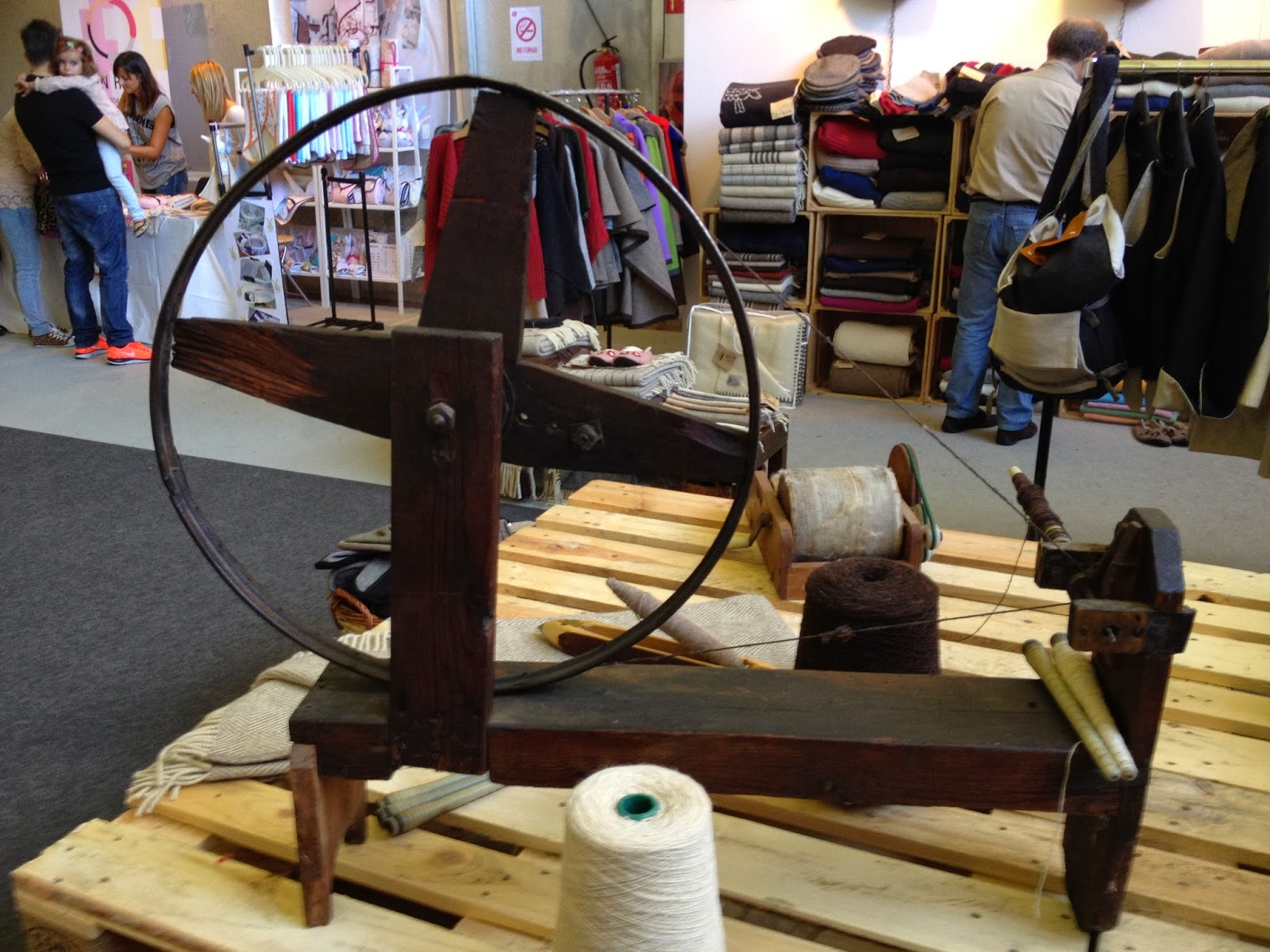
A spindle wheel, like a huge charka, or maybe just a bobbin winder?


Some of their projects, don't you think that you would be a set for winter with those slippers and that cuddly blanket?


And also some of the spun wool on cones, waiting be woven. What I could not get was a good picture of is in that box. It was a white, un-spun wool where both plies were wrapped together. Maybe the only spinning happens in the plying? Their products were mostly soft and had a felted look. Maybe it was not spun to make the felting process easier and the result softer? 


This last image is stolen from directly off of the Nómada Market FB page, however it features yours truly and the DH. I have a feeling that they included my picture to give a more 'international feel" to the event. However, I guess that I can understand the sentiment. What did we win? Yarn! However, even though it was made in Spain (Katia), it was 100% acrylic. Maybe next year?


Saturday, October 5, 2013

What type of yarn can you spin on a spindle?

Bilingual post coming soon, on my other blog.

I have had spindles on the brain recently for two very good reasons. 
First, we now have a spinning group here in Madrid! "Hilando Madrid" is a small group of really great people and this Sunday we will be having our second meeting! If you are in Madrid and interested in going, stop by our Ravely group (if you are a Spanish speaker) or email me (if you need details in English). Last time we all spun on spindles. We spin on spindles because they are very portable and can be used virtually anywhere and in very tight places.


Secondly, I want to try teaching fiber arts, instead of English, this semester and I am determined to make that happen. So, for the past week or so I have been madly putting together spindle-spun samples. The best part about these preparations are the mini-skeins of art yarn I am making. Odds are my student will not be able to haul a wheel into class and this had me thinking about the various types of yarn that you can make with a spindle.

Hint: there are more varieties of art yarn that you can make on a spindle than you might think. Some of the following samples were made with a wheel, but I know that they can be made with a spindle too.

Here is a photo of all of my mini skeins together.


OK, let's get a close up view and more detailed descriptions of them:

Here is a beaded yarn Consisting of 2 plies of Polworth wool and 1 ply of grey cotton thread strung with beads. Yes I plied this on a spindle, it is all about the angle you ply and the trick of holding about 5 beads or so in your hand. I put in a bead about every 20 cm. Not that I was obsessive about the distance of the beads, it just ended up being a good rhythm. The best thing about plying this kind of yarn on a spindle, is you can make the process as slow as you want giving you more time to construct your perfect yarn.


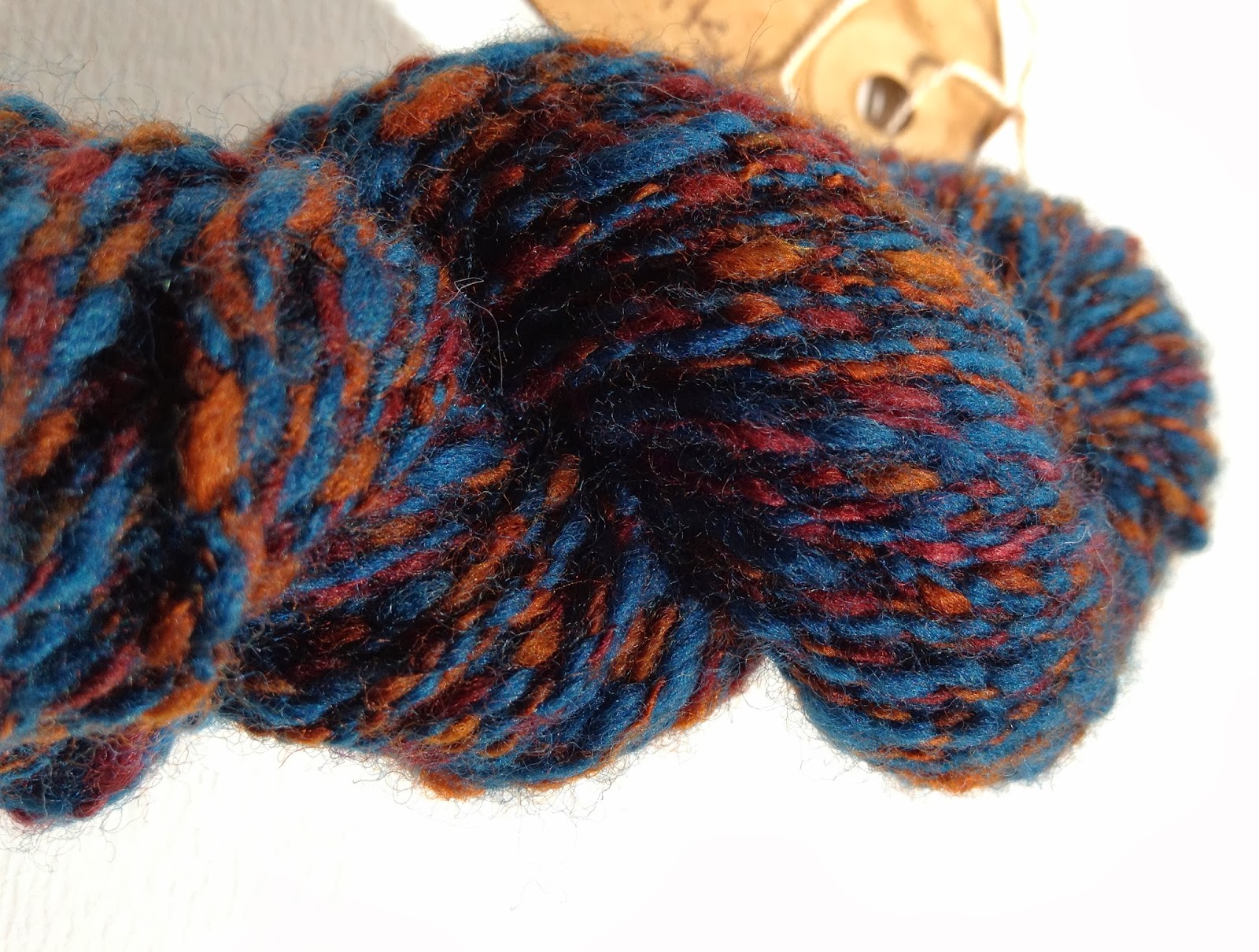
 This next one, was a two ply yarn I had in my hand-spun stash for a while. One ply is blue and the other is red orange. since each ply is a separate color, I decided it would be a good example of a cable plied yarn. This was originally spun on my wheel, but cable plied on my spindle. A basic 4 ply cable (it can be more plies) is a highly twisted 2 ply yarns that are plied together in the direction of the original singles. The result is a hard wearing, very strong yarn.


Navajo plying, or chain plying, on a spindle can be done as you go or after you have spun all of your singles, like I did here.


Yes core spun yarn can be spun on a spindle! Although if you pick a mostly black batt to spin from, it can be very hard to photograph. I was inspired to try it from this video, but technique is not showed very clearly. Basically, you draft lose fluffy fiber at a 45 degree angle to a "core yarn". This method allows the fiber to wrap around the core completely hiding the core yarn (a strong cotton works well as the core yarn). It is a great method for producing bulky art yarn out of those art batts you have no idea how to use.


This next is a think and thin singles* plied with cotton, threaded with beads and sequins. If you hold the singles at a 45 degree angle to the cotton while plying, you can create a spiral effect as well.


Then there is the thick and thin singles yarn plied with just a cotton thread. I made this from a batt which I made using different pairings of complimentary colors.


And of course you can create more utilitarian yarns with a spindle.

Such as: a thick and thin, bulky 2 ply.
Recognize this color? It is left over from my brain project.


A standard hand dyed worsted spun 3 ply (in two different colorways)


A worsted spun 2 ply (top) and, my personal favorite to make on a spindle, the woolen spun 2 ply (bottom).


There is also the *singles yarn, this one is in hand dyed 50/50 merino/silk


What kind of art yarn/ yarn can you make on a spindle? Have you tried any of these techniques?

* Yes the correct term for a single ply is always plural. Don't you just love English?

Friday, November 23, 2012

Campaign for wool - Spain


From my other blog, this is to good to miss reading about. English is in italics and Spanish is below.

I am going to break the Trashumancia posts and put up this post, due to the fact that if you live in Madrid, and do not know about the campaign for wool events going on this week, you will still have a chance to go and see some events and the art after you have read this post. 

Voy a interrumpir los posts sobre la Trashumancia para poner este post, debido al hecho de que si vivís en Madrid, y no sabéis acerca de los eventos de la Campaña por la Lana que están ocurriendo esta semana, tendréis la oportunidad de ir a ver algún evento y el arte después de haber leído este post.

Why the campaign for wool on a Spanish historical spinning blog? To me wool is the basis for spinning, and the Campaign for Wool is history in the making. From the Campaigns website:


The Campaign for Wool is a truly collaborative initiative involving farmers, textile manufacturers, carpet makers, fashion & interior designers and artisans from around the world.  The Campaign for Wool is jointly funded by six of the biggest trade wool textile organisations...

¿Por qué la campaña para la lana en un blog sobre la historia del hilado en España? Para mí, la lana es la base para el hilado, y la Campaña por la lana es historia en movimiento. Del sitio web Campañas:

La Campaña por la Lana es una iniciativa llevada a cabo por Su Alteza Real el Príncipe de Gales, quien ha observado que la industria lanera se enfrenta con retos enormes y sin precedentes. La Campaña por la Lana es multinacional, multisectorial, integradora y procura abarcar todos los profesionales de la lana, desde las grandes empresas hasta los artesanos.

The campaign is lead by the Prince of Wales and is an effort to bring awareness of the properties of wool and the decline of the use of wool in textiles. It is common in Spain, as well as UK, that farmers will bury or burn the wool, as it is an annoying extra product off the sheep that they want to use for meat or milk. I have heard the amount of money that they get from selling the wool is less then they have to pay the shearer to shear the sheep in the first place. All non primitive breeds have to be shorn every year or the fleece can get too heavy and cause the sheep health problems. What that means for us spinners is that the sheep are not valued for their wool and therefore they are not being breed for it, the quality goes down, and there is even the potential for the breeds that do not give good milk or meat to die out.

La campaña está dirigida por el Príncipe de Gales y es un esfuerzo para crear conciencia de las propiedades de la lana y la disminución del uso de la lana en el sector textil. Es común en España, al igual que en el Reino Unido, que los ganaderos entierren o quemen la lana, ya que es un molesto producto adicional de las ovejas que se desean utilizar para carne o leche. He oído que la cantidad de dinero que obtienen por la venta de la lana es menos que lo que tienen que pagar al esquilador para esquilar las ovejas. Todas las razas no primitivas necesitan ser esquiladas cada año o la lana puede ser demasiado pesada y causar problemas de salud a las ovejas. Lo que esto significa para nosotros los hilanderos es que las ovejas no son apreciadas por su lana y por lo tanto no están siendo criadas para ello, la calidad disminuye, e incluso existe la posibilidad de que las razas que no dan buena leche o carne desaparezcan.

To me this campaign is frightfully important to bring awareness to the consumer, spinner or not. The campaign makes an effort to link wool to the fashion world by having models pose with the sheep and encouraging stores to join the campaign and highlight their wool products. If the fashion world makes a greater demand for better wool, spinners will benefit. The fashion world has the main control of  the wool market, whereas us spinners are just a drop in the bucket. This campaign is going strong in at least 8 countries and counting and I hope that it continues to thrive.

Para mí esta campaña es terriblemente importante para hacer tomar conciencia a los consumidores, hilanderos o no. La campaña hace un esfuerzo por vincular la lana con el mundo de la moda al hacer posar a modelos con las ovejas y alentar a las tiendas para unirse a la campaña y destacar sus productos de lana. Si el mundo de la moda hace que haya una mayor demanda de mejor lana, los hilanderos se beneficiarán. El mundo de la moda tiene el control principal del mercado de la lana, nosotros los hilandores somos sólo un pequeño porciento. Esta campaña va fuerte en al menos 8 países por ahora y espero que siga prosperando.

Now back to Madrid, Lana Connection, an urban knitting/yarn bombing group here in Madrid has done a wonderful job of coordinating the wool art installations here in Madrid. From the Lana Connection website:

Ahora, de vuelta a Madrid, Lana Connection, un grupo de urban knitting/yarn bombing aquí en Madrid ha hecho un trabajo maravilloso coordinando las instalaciones de arte de lana aquí en Madrid. Desde el sitio web de conexión Lana:

This exhibition was the collaboration of the following groups here in Spain:

En esta intervención han colaborado los siguientes grupos de España:

  • LanaConnection (Madrid) Diseño y coordinación
  • Comunidad de tejedoras de Amo el Amigurumi (Alicante)
  • La Guerrilla del ganchillo (Barcelona)
  • La Ganxetes del Portia (Reus)
  • La guerrilla de Gilda (Lleida)
  • Loving club de (Mallorca)
  • Urban Knittng Bilbao
  • Urban Knitting Valencia
  • “Lacraftytienda” The Home Made (Vigo)
  • Urban Knitting Zaragoza
  • Yarn Bombing ACoruña
  • Madrid Knit


The theme for this year was the four seasons and they have done it well with two knitted or crocheted scenes from every season and themed knitted bunting running up and away from each season. I loved winter the best, but all of it was breath taking. A lot of work went into these and I am proud of the representation of my craft. As always click to enlarge. I have found a video that documents that yarn bombing by Lana Connection. 


El tema para este año fueron las cuatro estaciones del año y lo han hecho bien con dos escenas de punto o ganchillo por cada temporada, y ristras temáticas de punto conectando cada temporada. Me encantó el invierno sobre todo, pero todo fue impresionante. Se puso una gran cantidad de trabajo en cada uno y me siento orgullosa de la representación de mi medio. Como siempre clic para ampliar. He encontrado un video que documenta que yarn bombing por Lana Connection.

Winter / invierno

Winter / invierno

Winter / invierno


Winter / invierno

I love the Spanish touches, for example in the photo below the chocolate and churros....

Me encantan los detalles españoles, por ejemplo en la foto de abajo el chocolate y churros ....

Winter / invierno

and a three kings cake.

Y un roscón de reyes.

Winter / invierno

Summer / verano

Summer / verano

Summer / verano

Summer / verano

Summer / verano

Summer / verano

Spring / primavera

Spring / primavera

Autumn / otoño
Autumn / otoño
Autumn / otoño
On Serrano across from the Jardines del Descubrimiento were some educational stations about wool. Including un-processed and processed wool, a weaving demonstration, of course a spinning demonstration, and, naturally, sheep! There were at least four different breeds that I made out, and they certainly were attracting attention.

En Serrano frente a los Jardines del Descubrimiento había algunas estaciones educativas sobre la lana, incluyendo una sobre lana sin procesar y procesada, una demostración de tejido, por supuesto una demostración de hilado, y, naturalmente, las ovejas! Habían por lo menos cuatro razas diferentes por lo que yo sé, y ciertamente llamaban la atención de la gente.