My holiday themed felting continues today with a Cagatío. A Cagatío is a Catalonian tradition that I am fascinated with, and apparently I am not alone. If this post peaks your interest go and read this blog post too, I highly recommend it.
A Cagatío is a log with a face painted on it. Usually standing on 2-4 legs and wearing a traditional Catalonian hat. The condensed version of what it is (really go and read that blog post) is that you feed the log all through the season and it grows and grows. Then when they big day arrives the children beat the log with a stick until it poops presents. (There are songs and everything.) Putting aside the message that it is ok to beat something you have cared for for a month, it is a great idea! The growing log, and the pooing of presents creates an air of magic around the season, and the energetic whacking is sure to make the kids have a calm afternoon.
To be clear these are only really found in Catalonia. It is the Spanish side of my family who introduced me to them. Sadly they are not something readily available here in Madrid.
If I were to make this over again I would have made the legs thinner, to make them appear more stick-like and less log-like.
I am starting to get into the holiday spirt, are you?
I am wondering if I should give my self a another challenge and make a holiday themed felted creature a day. Kind of like a mini advent calendar. (Mini because I am starting late.) I made these two guys today.
For the moose I decided that if I am going to go cartoon, I should go all the way and experiment with yarn legs. Everyone knows that moose have long straggly legs, why not triple up some handspun, attach it to the body and felt a hoof on the other end? I have to say, I love the effect!
Next up is one on my "sheep nuggets" with a Catalonian type hat on.
And just for fun I bought a new home for María, José, and Jesus. I made them last year. Read about it here. It gives them a more solemn air. I'll bet that makes my friend Susana happy. ;)
There is a romantic style garden near my house that I have only been to 3 times despite having lived here for over a year now. It is a problem of distance. It is far enough from home that it seems like a long distance to walk to, and then go exploring in the gardens, but too close to pay to take public transport. It is a good way to get in a 6.5km walk though and I am going to try and go more often.
Here in Madrid we are still in the final stages of autumn, even in early December.
This garden is not as grand as most I have been to, but it is still a reminder of the sense of past us US citizens crave. As I walked through the park today I wondered: "would this garden's historical features have been more impressive to me if I was just here for a visit? Am I starting to get used to seeing old buildings and that has taken away their impact? Or maybe becoming accustomed to the Europe-ness of my surroundings makes me now better able to single out the things of great beauty?" Food for thought. What do you think?
Talking about great beauty, this Gingko tree was straight from a fairy tale. It is really hard to get a picture that capture's it's beauty. It's golden leaves and the way that they fell 'just so' on the lush green grass underneath, made the whole journey more than worth it. I was not the only one it affected, there was a man walking my way who kept glancing back. I thought that he was waiting for a dog, but I never saw one.
Those rich people knew how to construct even their gardener's huts with style.
That antenna is one of the more recognizable in Madrid. Sometimes when I am across the city and I see it I realize just how small the footprint of Madrid is compared to some US cities.
What you can not tell from these photos is that it is so cold there is frost on the ground in the shade, yet the roses still bloom.
Madrid really has two seasons: hot & dry, and cold & wet.
So there was my walk for this morning. Excuse well I go get out my dye-pot and get to work.
Things I still find very odd about Spain/Madrid after 2.5 years...
Since I live in Madrid some of these things might only be local phenomenon.
Disclaimer: These things are not bad things, just things that this American still finds odd.
The knife sharpener - afilador de cuchillos
These guys cycle around the neighborhood playing pan pipes to et everyone know that they are there. The point is that they will sharpen your knives. You go down and meet them and then you can have your knives nice and sharp without you having to really transport them far. While part of me thinks that this is charming, another part of me would never go running to a stranger on the street and offer him a knife.
That is the best name I can think of for them. It is really a serious throwback to the 60's when you hear them. They're vans that play an advertisement on a loop blasted from a speaker atop the van. The ads are mostly directed towards housewives (at least the ones I have heard). Seriously, people still advertise this way, no web pages for them! It is not even a good way to advertise as the commercials are often so long that you only hear part of it. Often you hear only part of a phone number too.
Christmas presents are brought by the three kings....
It is a reminder that you are far from home when you realize that every country has their own Christmas traditions. In Spain the presents are brought, by camel, by the Three Kings on January 6th. Making Spain one of the countries that actually celebrate the 12 days of Christmas. Although increasingly kids are getting their presents on the 25th of December so as to have time to play with them on Christmas break.
I won't get into the problems I have had with Veterinarians here, but the lack of appointment is still odd to this day. You could wait for hours or minutes.
(I have also witnessed at least two Vets leave a patient under anestesia in surgery to see other clients. (Shudder))
The last Metro leaves the first stop of the route at 1:30 am
In Spain where Dinner is at 10pm, going for tapas can last late into the night, and "Discos" open at 2am - the metro time table just des not make sense.
I have mixed feelings about the Campaign here in Madrid and you will shortly see why. (Although the rumors that they used acrylic yarn last year are not true.)
First lets watch the video from last year, the English version, and you can see what a great and spectacular show that was put on last year, 2012.
Also here is a link to my bi-lingual post about last year's Campaign.
This years's Campaign was smaller, which I suppose was to be expected. The economy in Spain is not good, and the government seems to be making it worse. There was only 2 educational/showcase spots for the Campaign this year.
But there were sheep in the sidewalk of Serrano in Madrid's most elite shopping district.
Doing what sheep do.
Next to the sheep was an English garden complete with knitted accents.
There were a couple of informative posters here and there. I was very surprised and pleased to see this one detailed 5 different breeds of Spanish sheep. You rarely see something this educational about wool here. However, I think that they must be the 5 most famous breeds of sheep in the country because there is actually at least 52 Spanish breeds. But I suppose that the point of the Campaign is to reach the average person and promote the usefulness of wool, not to reach and educate crafters of wool. (Click to enlarge.)
This next sign was not illustrated (or checked over) by any one that has ever really worked with wool. Still I suppose that the educational spirt was there. (Click to enlarge and see the pictures.)
There were also little informative signs in the garden.
The stroke of genius this year was that someone had the idea to hire male models to walk the sheep around and answer questions while being dressed in wool like a chic shepherd. Last year there were a lot of female models wearing the latest in wool (and little of it). This year's models resemblance to the shepherds of the past combined with the chic "tweed" look of today was perfect. (No they did not know much about wool, but they were super helpful.)
Either more stores participated this year or the route between the two educational spots was well lined, because almost every store you walked by was participating.
Some of the uses of the wool in the displays were...interesting, but maybe that's the fashion world for you.
The great thing about coming out to this shopping district (it is not someplace that I do regularly) was seeing that a lot of the well to do people were wearing a lot of wool already. The tweed look is very in right now, it is avery wool friendly look and I love it.
The store with this type of sign were not selling yarn, much to my disappointment, but the displays were super cute.
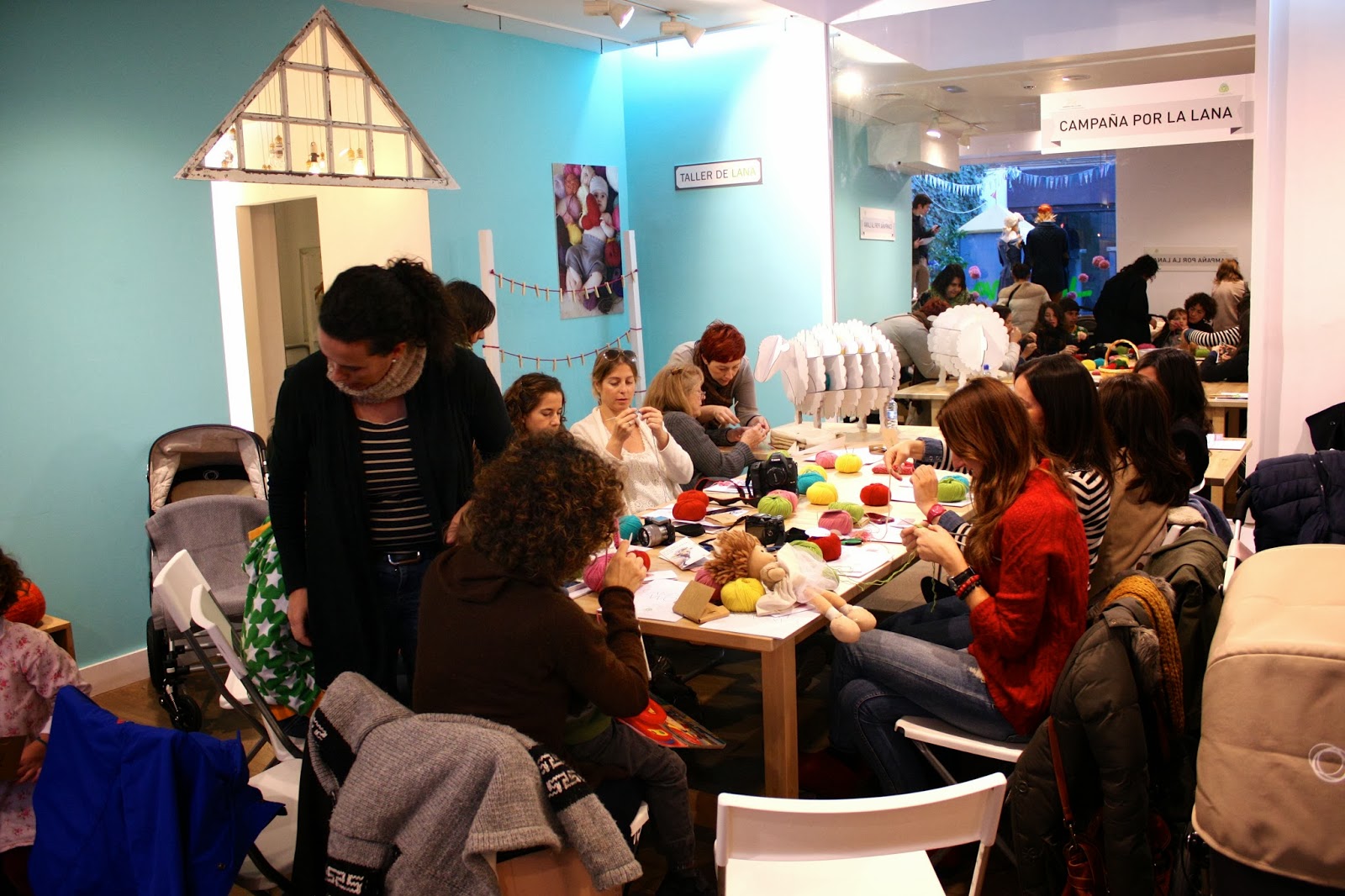
The second educational spot, a pop up store, located off of Calle Jorge Juan definitely got high points for presentation.
There were goodies and information packets. Here is where I have mixed feelings about the campaign. I love wool, I love to teach others about wool and the crafts associated to it. I know that for the general public too much information can be a bad thing...
but look at those "wool" samples on the table. They are in cute little boxes with a baby on them. There was NO information on them, save the advertiser's: Woolmark. No fun facts, no information indicating what the fiber is, no reasons for the sample in the first place. Also...it was silk (I did a burn test on both). OK silk is a natural fiber, but that is not the point, is it? Also this type of silk is not a renewable resource, the worm dies in the process. Silk does not promote the use of wool. Also Silk is generally more expensive than wool, why give it out as a sample indicating (by it's presence in the Campaign, not information on the box) it as wool?
There were two kinds of samples and the other was a very soft merino wool (not that you could tell from the boxes). The samples of wool were a nice touch.
But something to make you spinners cringe... the wool samples were cut into lengths. Shudder.
There was an area where people could learn how to knit, and they were knitting with wool. A very good idea. More knitters equals more demand for higher grade wool, and maybe down the road, the demand for breed conservation and the conservation of colored fleeces.
This little girl is an early convert and was singing "Paseo de la lana!" (Avenue of wool is a rough translation) over and over as she walked behind us to the pop-up store.
Do you have mixed feelings about this campaign for wool as well? Or is a little education (even if some of it is misrepresented) better than nothing?