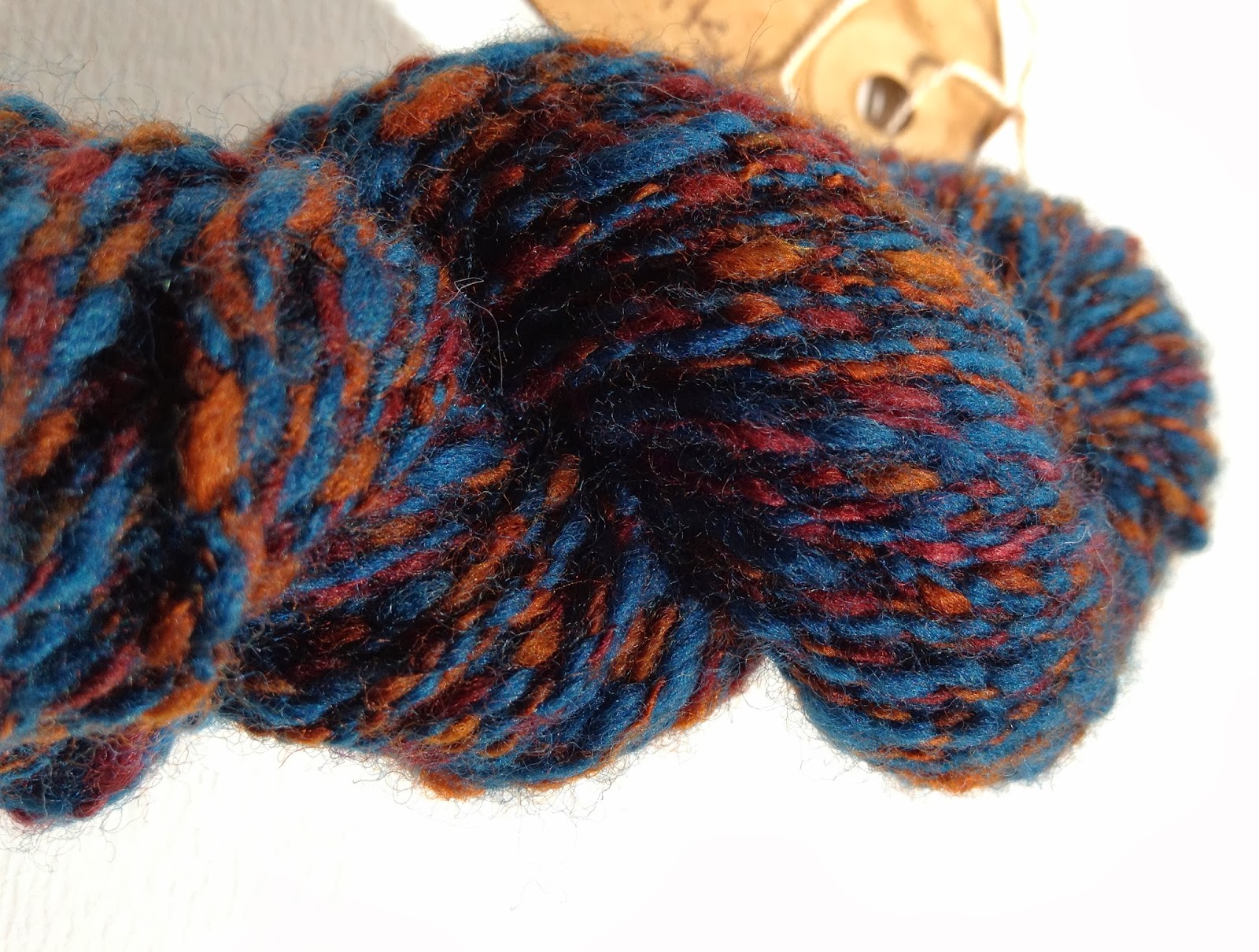
Showing posts with label lana. Show all posts

Sunday, November 24, 2013

campaña por la lana

The Campaign for Wool was begun by the Prince of Wales and has spread to many cities, Madrid being one of them

I have mixed feelings about the Campaign here in Madrid and you will shortly see why. (Although the rumors that they used acrylic yarn last year are not true.)

First lets watch the video from last year, the English version, and you can see what a great and spectacular show that was put on last year, 2012.


Also here is a link to my bi-lingual post about last year's Campaign.

This years's Campaign was smaller, which I suppose was to be expected. The economy in Spain is not good, and the government seems to be making it worse. There was only 2 educational/showcase spots for the Campaign this year. 


But there were sheep in the sidewalk of Serrano in Madrid's most elite shopping district.


Doing what sheep do.


Next to the sheep was an English garden complete with knitted accents.


There were a couple of informative posters here and there. I was very surprised and pleased to see this one detailed 5 different breeds of Spanish sheep. You rarely see something this educational about wool here. However, I think that they must be the 5 most famous breeds of sheep in the country because there is actually at least 52 Spanish breeds. But I suppose that the point of the Campaign is to reach the average person and promote the usefulness of wool, not to reach and educate crafters of wool. (Click to enlarge.)


This next sign was not illustrated (or checked over) by any one that has ever really worked with wool. Still I suppose that the educational spirt was there. (Click to enlarge and see the pictures.)


There were also little informative signs in the garden.


The stroke of genius this year was that someone had the idea to hire male models to walk the sheep around and answer questions while being dressed in wool like a chic shepherd. Last year there were a lot of female models wearing the latest in wool (and little of it). This year's models resemblance to the shepherds of the past combined with the chic "tweed" look of today was perfect. (No they did not know much about wool, but they were super helpful.) 


Either more stores participated this year or the route between the two educational spots was well lined, because almost every store you walked by was participating.
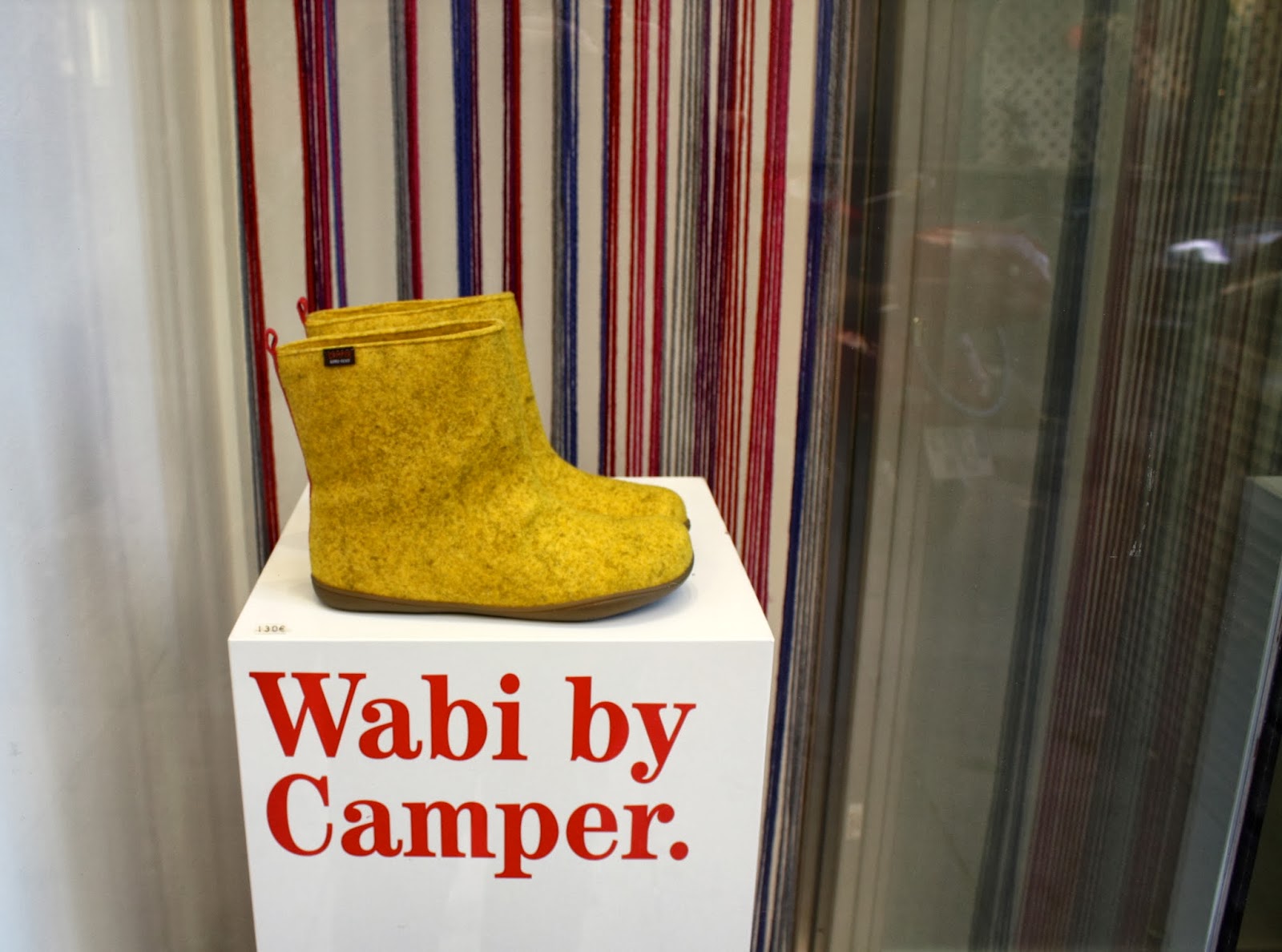


Some of the uses of the wool in the displays were...interesting, but maybe that's the fashion world for you.


The great thing about coming out to this shopping district (it is not someplace that I do regularly) was seeing that a lot of the well to do people were wearing a lot of wool already. The tweed look is very in right now, it is avery wool friendly look and I love it.


The store with this type of sign were not selling yarn, much to my disappointment, but the displays were super cute.


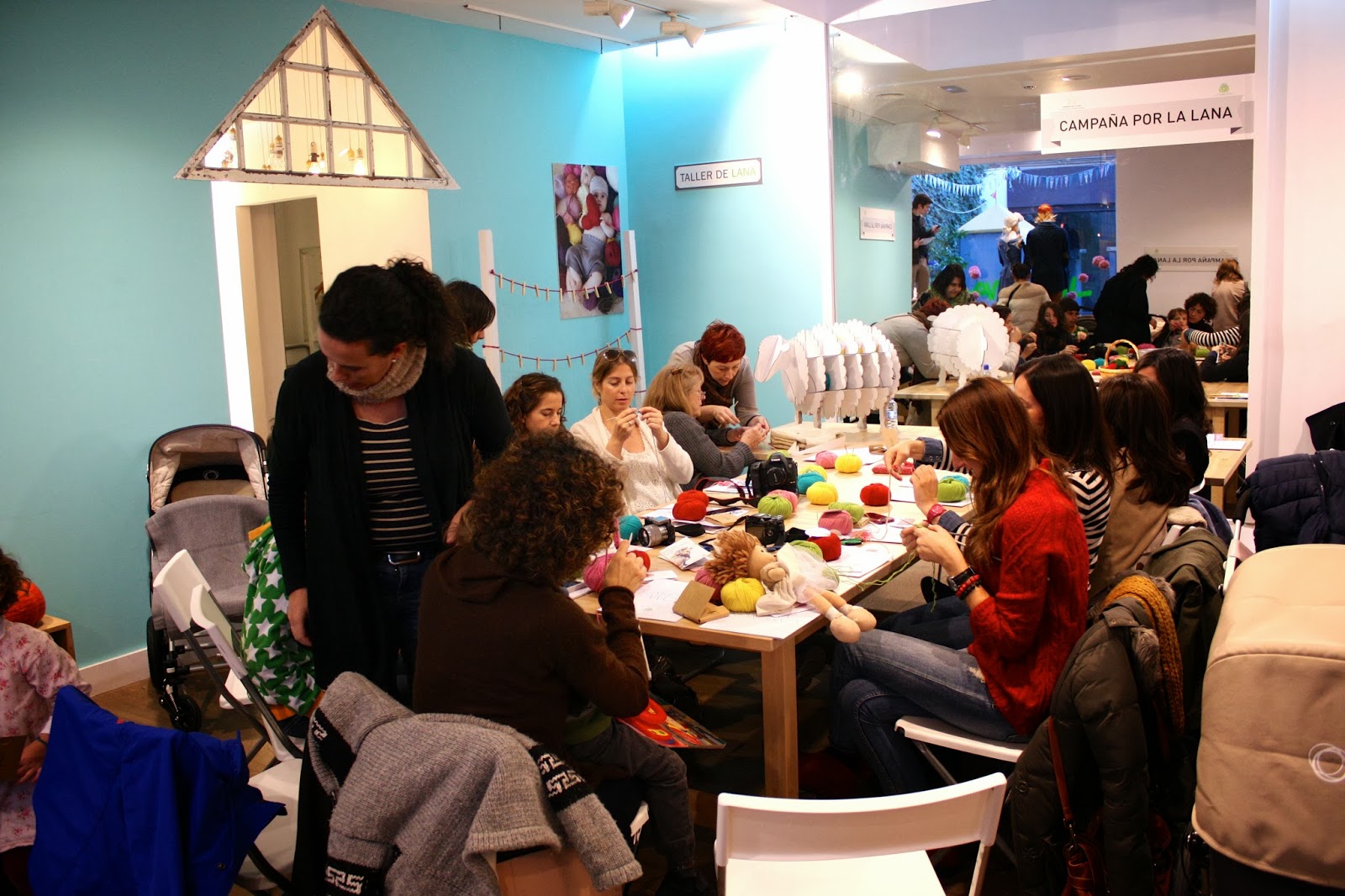
The second educational spot, a pop up store, located off of Calle Jorge Juan definitely got high points for presentation.


There were goodies and information packets. Here is where I have mixed feelings about the campaign. I love wool, I love to teach others about wool and the crafts associated to it. I know that for the general public too much information can be a bad thing...
but look at those "wool" samples on the table. They are in cute little boxes with a baby on them. There was NO information on them, save the advertiser's: Woolmark. No fun facts, no information indicating what the fiber is, no reasons for the sample in the first place. Also...it was silk (I did a burn test on both). OK silk is a natural fiber, but that is not the point, is it? Also this type of silk is not a renewable resource, the worm dies in the process. Silk does not promote the use of wool. Also Silk is generally more expensive than wool, why give it out as a sample indicating (by it's presence in the Campaign, not information on the box) it as wool?

There were two kinds of samples and the other was a very soft merino wool (not that you could tell from the boxes). The samples of wool were a nice touch.

But something to make you spinners cringe... the wool samples were cut into lengths. Shudder.


There was an area where people could learn how to knit, and they were knitting with wool. A very good idea. More knitters equals more demand for higher grade wool, and maybe down the road, the demand for breed conservation and the conservation of colored fleeces.

This little girl is an early convert and was singing "Paseo de la lana!" (Avenue of wool is a rough translation) over and over as she walked behind us to the pop-up store.


Do you have mixed feelings about this campaign for wool as well? Or is a little education (even if some of it is misrepresented) better than nothing?

Saturday, October 5, 2013

What type of yarn can you spin on a spindle?

Bilingual post coming soon, on my other blog.

I have had spindles on the brain recently for two very good reasons. 
First, we now have a spinning group here in Madrid! "Hilando Madrid" is a small group of really great people and this Sunday we will be having our second meeting! If you are in Madrid and interested in going, stop by our Ravely group (if you are a Spanish speaker) or email me (if you need details in English). Last time we all spun on spindles. We spin on spindles because they are very portable and can be used virtually anywhere and in very tight places.


Secondly, I want to try teaching fiber arts, instead of English, this semester and I am determined to make that happen. So, for the past week or so I have been madly putting together spindle-spun samples. The best part about these preparations are the mini-skeins of art yarn I am making. Odds are my student will not be able to haul a wheel into class and this had me thinking about the various types of yarn that you can make with a spindle.

Hint: there are more varieties of art yarn that you can make on a spindle than you might think. Some of the following samples were made with a wheel, but I know that they can be made with a spindle too.

Here is a photo of all of my mini skeins together.


OK, let's get a close up view and more detailed descriptions of them:

Here is a beaded yarn Consisting of 2 plies of Polworth wool and 1 ply of grey cotton thread strung with beads. Yes I plied this on a spindle, it is all about the angle you ply and the trick of holding about 5 beads or so in your hand. I put in a bead about every 20 cm. Not that I was obsessive about the distance of the beads, it just ended up being a good rhythm. The best thing about plying this kind of yarn on a spindle, is you can make the process as slow as you want giving you more time to construct your perfect yarn.


 This next one, was a two ply yarn I had in my hand-spun stash for a while. One ply is blue and the other is red orange. since each ply is a separate color, I decided it would be a good example of a cable plied yarn. This was originally spun on my wheel, but cable plied on my spindle. A basic 4 ply cable (it can be more plies) is a highly twisted 2 ply yarns that are plied together in the direction of the original singles. The result is a hard wearing, very strong yarn.


Navajo plying, or chain plying, on a spindle can be done as you go or after you have spun all of your singles, like I did here.


Yes core spun yarn can be spun on a spindle! Although if you pick a mostly black batt to spin from, it can be very hard to photograph. I was inspired to try it from this video, but technique is not showed very clearly. Basically, you draft lose fluffy fiber at a 45 degree angle to a "core yarn". This method allows the fiber to wrap around the core completely hiding the core yarn (a strong cotton works well as the core yarn). It is a great method for producing bulky art yarn out of those art batts you have no idea how to use.


This next is a think and thin singles* plied with cotton, threaded with beads and sequins. If you hold the singles at a 45 degree angle to the cotton while plying, you can create a spiral effect as well.


Then there is the thick and thin singles yarn plied with just a cotton thread. I made this from a batt which I made using different pairings of complimentary colors.


And of course you can create more utilitarian yarns with a spindle.

Such as: a thick and thin, bulky 2 ply.
Recognize this color? It is left over from my brain project.


A standard hand dyed worsted spun 3 ply (in two different colorways)


A worsted spun 2 ply (top) and, my personal favorite to make on a spindle, the woolen spun 2 ply (bottom).


There is also the *singles yarn, this one is in hand dyed 50/50 merino/silk


What kind of art yarn/ yarn can you make on a spindle? Have you tried any of these techniques?

* Yes the correct term for a single ply is always plural. Don't you just love English?

Tuesday, July 23, 2013

Museo Etnologico de Chinchón/ ethnological museum of Chinchón

There is a nice little folk museum in Chinchón, and it is the main reason for us going there. We knew that there was a textile section. So how do you find this museum on an out-of-the-way side street? If you are in the plaza mayor and facing the church you will make out that there is a pedestrian archway up and to the left.

Hay un pequeño museo etnológico en Chinchón, y es la razón principal por la que fuimos allí. Sabíamos que había una sección textil. Así que, ¿cómo encontrar este museo en una pequeña y apartada calle? Si estás en la Plaza Mayor y encarando la iglesia verás que hay una arcada peatonal arriba y hacia la izquierda.


Here is a close up of the archway. I should probably take this opportunity to mention it is a very small museum, and the information signs are only in Spanish.

Aquí podéis ver un primer plano de la arcada. Probablemente debería aprovechar esta oportunidad para mencionar que es un pequeño museo, y que toda la información está sólo en español.


You go through and  will see this sign to your left, then you know that you are on the right track. It is just up this road about 100 meters to your left.

Cuando cruces verás esta señal a la izquierda, entonces sabrás que estás en el camino correcto. Está a unos 100 metros a la izquierda.


Technically I was not allowed to take these pictures. However, I took these without flash and for educational purposes. The main textile section is up on the 2nd (for the US the 3rd) floor. There is a selection of traditional clothing that you can see as you enter the museum, but up here you can see the tools used for making the textiles.

Técnicamente no se me permitió tomar estas fotos. Sin embargo, las tomé sin flash y con propósitos educativos. La sección textil principal está arriba en el segundo piso. Hay una selección de ropa tradicional que se puede ver al entrar en el museo, pero en el segundo piso puedes ver las herramientas que se utilizan para la fabricación de los textiles.

There were hanks of wool hanging from the rafters and the walls. There were really no signs about the wool, other than who donated it, but they remind me of the skeins at the Royal Tapestry Museum in Madrid. The skeins at the Tapestry museum were from Spanish Merino and spun and dyed somewhere in Toledo. Since there were also no signs saying not to touch, I did, and it certainly felt like 100% wool that could have been Spanish merino.

Había madejas de lana colgando de las vigas y las paredes. No había señales sobre la lana, excepto quien la donó, pero me recuerdan a las madejas en la Real Fabrica de Tapices en Madrid. Los ovillos en el museo de tapices eran de merino Español, hilados y teñidos en Toledo. No había señales diciendo que no tocara, así que lo hice, y ciertamente parecía 100% lana que podría haber sido merino Español.


They look like could have been dyed with natural dyes too.

También parecían haber sido teñidos con tintes naturales.


Here are the two informational signs located to the side of a huge rug loom.

Estos son los dos carteles informativos situados al lado de un enorme telar de alfombras.


My translation of the sign below:
"In the 1950s there were many grand mansions that were converted into workshops for making Spanish knotted rugs. The female pioneers that started this activity and gave jobs to around 200 local women were 14 young women that learned in the a foundation called Fundación Generalísimo.
At full capacity they worked (in this city) on around 50 looms until 1967, at this time this type of work practically disappeared.
Each woman had her own space of 120 rows to knot, which measured about half a meter and they received 8 pesetas (0.048€) for every 100 knots. She was only paid when the rug was finished. The weavers that wanted to receive a reasonable salary would have had to do 12,500 knots each day.
A rug that was 3.5meters long and 2.5 meters wide would have been woven by 5 women and made in 15 days. It would have been sold for 15,000 pesetas (less than 100 Euros).
It was very hard work, because of the tightness of the warp and the continuous use of scissors caused various deformities to the woman's hands; added to this was the fact that the wool gave off a noxious dust that the workers continually breathed in.
Something particular about the "Spanish knot" technique is that you don´t use any type of machine: all of the process is done by hand, every thread is a knot, and knot by knot you weave the rug to completion. The peculiarity that there are neither shuttles nor any other type of mechanism has situated our rugs among the best in the world. If you examine the back of the rug you can see the same design that you see on the front."

Arriba está la traducción en inglés de este cartel; pulsa para ampliar y leer el cartel original en Español.

This next sign reads:
"Antique loom of Chinchón, 
for rugs using Spanish knot
(first part of the 20th century)
Recovered by this museum, and actually put to work to make rugs again.
The loom and all of the skeins of wool were donated by Mr. Pedro Del Nero."
So here is the loom. Hand knotted rug means that instead of weaving, each point of color is knotted around the warp and the ends are snipped off with a pair of scissors. So the knots are at the base of the rug and the yarn ends serve as the carpet pile. Every couple of rows of knots there is a line of jute fiber put in between the warp and packed down. The jute fiber adds stability and longevity to the rug. What I know about the "Spanish knot" that remember from my tour of the Royal tapestry museum, is that it is a different and more complicated knot than regular hand knotted rug.

Así que aquí está el telar. Una alfombra de nudos implica que, en lugar de tejer, cada punto de color se anuda alrededor de la urdimbre y los extremos se cortan con unas tijeras. Así que los nudos están en la base de la alfombra y los hilos terminales son como el pelo de la alfombra. Cada par de filas de nudos hay una línea de fibra de yute que se pone entre la urdimbre y se compacta. La fibra de yute añade estabilidad y longevidad a la alfombra. Lo que sé sobre el "nudo español" de lo que me acuerdo de mi recorrido por la Real Fabrica de Tapices, es que es un nudo diferente y más complicado que otros nudos.

Do you see the drawing behind and in front of the weft? (Click to enlarge.) That is called a cartoon and is kind of a colored graft that allows the rug makers to follow the pattern. 

¿Ves el dibujo detrás y delante de la urdimbre? (Haz clic para ampliar.) Eso se llama un cartón y permite a los fabricantes de alfombras seguir el patrón.


A side view of the loom, where you can see that you can raise or lower the loom to get the right tension on the warp.

Una vista lateral del telar, donde puedes ver que se puede subir o bajar el telar para obtener la tensión correcta en la urdimbre.


This is a warping board. The zig-zag pegs at either end make it possible to measure a very long warp in a small space.

Esto se usa para medir el urdido. Las clavijas en los dos lados hacen que sea posible medir un urdido muy largo en un espacio pequeño.


A finished Spanish knotted rug hung up on the wall.

Una alfombra de nudo español acabada y colgada en la pared.


A close up of the rug that was hanging on the loom. Just imagine how plush it would be for tired feet, especially in winter. If this post has made you want your own Spanish knotted rug I believe that the Royal tapestry museum still makes them to order, but I have to warn you they do pay their laborers fair wages and these take hours to make, so it will be an investment.

Un primer plano de la alfombra que colgaba en el telar. Imaginaos la sensación para los pies cansados​​, especialmente en el invierno. Si este post te ha hecho querer tu propia alfombra de nudo español, creo que en la Real Fabrica de Tapices todavía los hacen de encargo, pero tengo que advertirte que pagan a sus trabajadores salarios justos y se tardan muchas horas para hacer una alfombra, por lo que será una inversión.